


Tango Monastery, formally known as Tango Choeying Phodrang, is one of the most sacred Buddhist sites and top attractions in Thimphu, Bhutan. Tango monastery hike in Bhutan rarely appears in itineraries but it is an incredible experience that one should not miss. Located just 14 kilometers north of Thimphu on a scenic, forested hillside, this historic citadel serves as Bhutan’s premier center for higher Buddhist studies and monastic university education.
The hills north of Thimphu have a way of making the city feel surprisingly distant. The roads become quieter, the forests thicker, and before long, the familiar bustle of the capital gives way to pine-covered slopes and the occasional prayer flag fluttering in the breeze. Somewhere beyond the forest, high above the valley, sits Tango Monastery.
I had seen photographs of Tango (pronounced ‘Taahng-go’ with a soft ‘T’). before coming to Bhutan, but photographs have a habit of making mountains look considerably easier to reach than they actually are. Naturally, Tango Monastery hike would become a part of my itinerary. From a distance, the monastery appears almost impossibly high on the hillside. Up close, I would discover that getting there involved a fair amount of uphill walking.
My guide, Sonam, told me that Dodena was about 16 kilometers from Thimphu, roughly a 45-minute drive. We followed the Dechencholing-Dodena Road towards the northern edge of the city. The further we went, the more the urban landscape disappeared behind us. By the time we reached the Dodena parking area, I was ready to leave the vehicle and start walking.
Tango Monastery hike begins from this point.
Tango Monastery Hike
From the parking area, a narrow flagstone path leads into the forest. Pine and juniper trees surrounded us, with the occasional Castanopsis appearing along the way. I recognized those three, which I considered a reasonable botanical achievement. The names of most of the other trees remained a mystery to me, and I decided not to embarrass myself by inventing them.
The forest was remarkably peaceful. Every so often, we would pass cheerful hikers coming back down from the monastery. Many of the women were dressed in colorful traditional Bhutanese clothing, which stood out beautifully against the deep green of the forest. A friendly greeting was usually exchanged before they continued downhill and we carried on upwards.
The trail was not particularly long, but it certainly wasn’t flat. In places, the path became quite steep, and I began to appreciate why people call this a hike rather than a stroll. Along the way, small chortens appeared beside the trail, some decorated with khadar, the silk scarves traditionally offered as a gesture of respect. Lungta prayer flags fluttered from nearby trees and poles, adding bursts of color to the quiet forest. It was one of those walks where the journey seemed to matter as much as the destination. Clichéd, I know!
A Thought Along the Trail
After walking for a while, I came across a board beside the trail. It carried a short message:
“If you want to know your past,
Look at who you are today.
If you want to know the future,
Look at your mind today.”
I stopped to read it twice.
There was something rather appropriate about encountering those words halfway up a mountain. I had been thinking mostly about the trail in front of me, and suddenly I was being encouraged to think about the past, the present and the future.
It made me wonder how much of our past is reflected in the person we have become, and how much of what comes next is already being shaped by the way we think today.
Then my legs reminded me that I was supposed to be walking, not writing a philosophy essay in my head.
So I continued uphill.
A little farther along, we came across another board, this one written entirely in Dzongkha. Fortunately, Sonam was with me. He translated it and explained that it contained a monastic decree, including a reference to Zhabdrung Ngawang Namgyal, the spiritual and political founder of Bhutan. The decree also outlined rules for preserving the purity and tranquillity of the area. Visitors were expected to avoid littering and to respect the peaceful nature of the sacred surroundings.
It seemed perfectly appropriate. There was something about the forest that encouraged you to lower your voice without anyone having to ask.
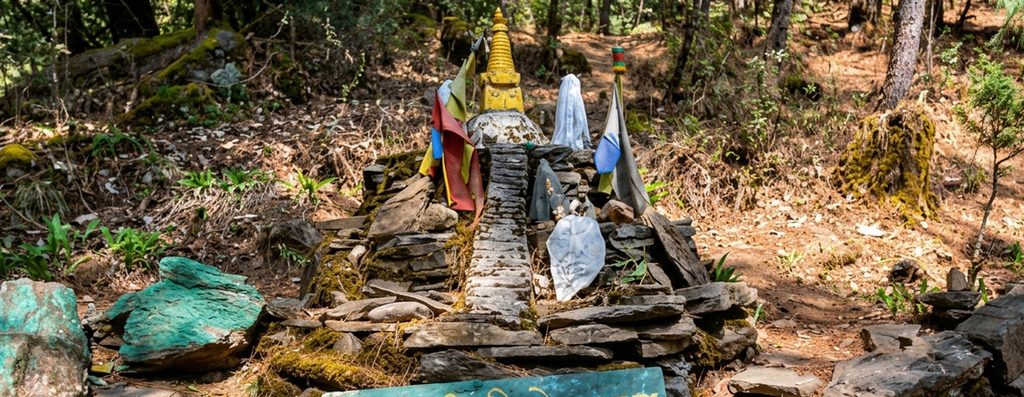
A View from the Forest
The Tango Monastery hike continued, and eventually we came to a small resting area. I took the opportunity to sit down for a few minutes.
From there, the forest seemed to stretch endlessly around us. Far below, the valley was beginning to open up, and the higher we had climbed, the more distant the roads and settlements seemed. After a short rest, we continued.
Then Tango appeared.
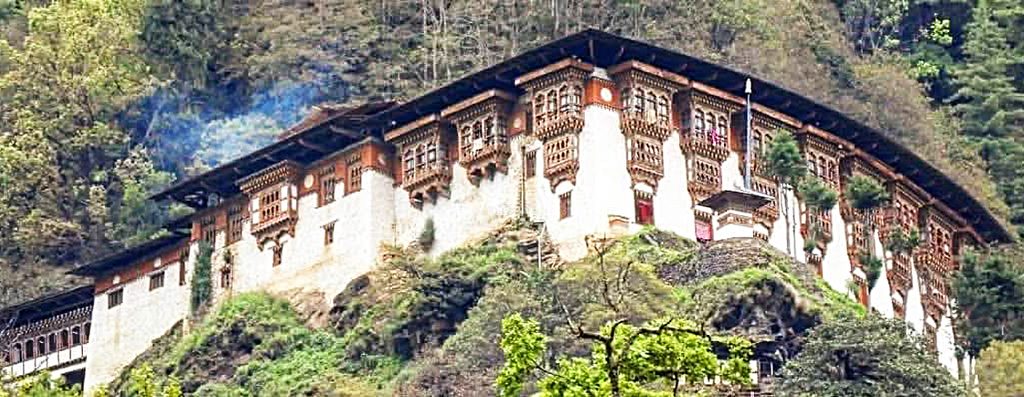
I first noticed the prayer flags. A vibrant line of colours climbed through the landscape, fluttering in the wind and seemingly following the direction of the trail. My eyes travelled upwards, and there it was: Tango Monastery, perched high on the mountainside.
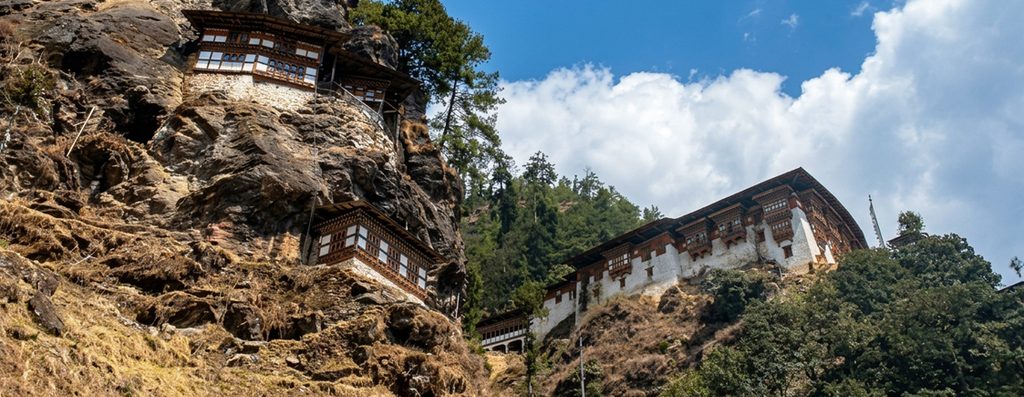
From below, the monastery looked almost as though it had been placed there rather than built. Its whitewashed walls and red bands stood out against the rugged hillside, and the sheer scale of the surrounding landscape made the buildings appear remarkably small.
For the first time since starting the hike, I stopped thinking about how much farther I had to go.
I simply looked. The final stretch was steep, with the trail winding its way towards the monastery. Looking back, I could see other hikers making their way up behind us, their colorful clothes appearing and disappearing between the trees and prayer flags.
It was a satisfying sight. Everyone seemed to be working towards the same destination, although I suspect we were each having a slightly different conversation with our legs.
Eventually, we reached Tango Monastery.
Standing there after the climb was a great feeling. The monastery’s traditional Bhutanese architecture was even more impressive up close, with its white walls, red details and carefully crafted wooden elements. The setting made it all the more striking. Tango is not simply surrounded by mountains. It seems to belong to them.
I walked around the complex with Sonam, taking in the buildings and the views. From this height, the forests seemed to roll away towards the valley, and the landscape that had looked so imposing from below now felt remarkably peaceful.
There was no need to rush.
Inside Tango Monastery
Inside, Tango felt very different from the forest trail outside. The rooms were richly decorated, with religious paintings covering the walls and large statues occupying the prayer halls. There are several temple areas spread across the monastery’s three floors, each with its own significance.
One of the first things that caught my attention was the enormous Buddha image in the main temple. Made of gold and copper, it rises several times the height of an ordinary person. Standing in front of it, I found myself looking upwards for rather longer than I had expected. Beside it were other Buddhist figures, including Maitreya and Dipankara Buddha, along with images of important spiritual figures.
Sonam explained the significance of the different images and paintings as we moved through the monastery. On another floor is an image of Avalokiteshvara, the Buddha of Compassion, along with a temple dedicated to Guru Rinpoche. There is also a shrine to Namsey, associated with wealth and prosperity.
The walls deserve attention too. Murals cover parts of all three floors, and they are remarkably detailed. Without the ability to take photographs, I found myself looking more carefully than I probably would have otherwise. I was trying to remember the colours, the faces, the expressions and the details of the paintings, knowing that I would have to rely on whatever my memory decided to preserve.
Some of the objects inside are connected directly with the history of Tango. There are sacred relics and unusual objects associated with the monastery’s religious figures, including a stone bearing what is believed to be a footprint and other revered impressions. The upper level also contains objects connected with Gyalse Tenzin Rabgye, under whose direction the present monastery was built.
I also appreciated the fact that I could not take photographs.
That may sound strange coming from someone who had spent much of the hike looking for good things to photograph. But being forced to leave the camera alone made me pay more attention. I had to look properly rather than take a picture and tell myself I would study it later.
Of course, whether I actually remembered all those details by the time I got back to Thimphu was another matter entirely.
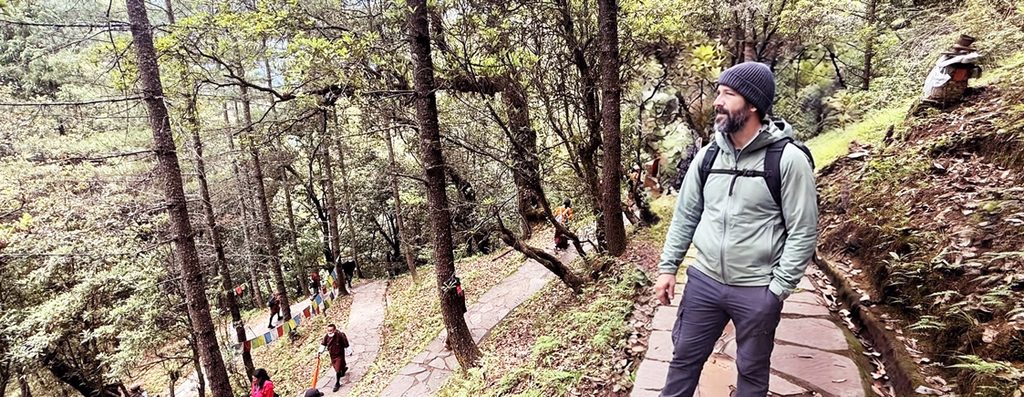
After spending some time at the monastery, we began our descent back towards Dodena. Going downhill was certainly easier in terms of breathing, although my knees had their own opinion about the matter.
The entire hike took me around two hours, including the stops along the way. Of course, driving to Dodena and spending time inside the monastery will take much more than that. But it depends on whether you interest is cultural insight or plain adventure.
When one reaches Tango, they understood why the monastery feels so removed from Thimphu, even though it is only a short drive from the capital. The distance is not really the point. It is the climb that creates the separation. And perhaps that is why the monastery feels so special when you finally reach it. But no matter what anyone tells you, the Tango Monastery hike itself is also quite invigorating.
