


For many decades, the Himalayas have been revered as one of the world’s greatest adventure destinations. It has been attracting avid trekkers and mountaineers who venture through its towering peaks and rugged terrains. Most travelers are often driven by the allure of conquering formidable mountains. Others come to enjoy panoramic views, and gain a sense of personal achievement. The idea of the Himalayas as a place for physical endurance and exploration has long captured the imagination of those seeking to push their limits. However, few consider the Himalayas as a destination for self-reflection or spiritual growth. In this context, the region is more commonly known as a land of adventure rather than a place for inner discovery.
Yet, beyond the quest for adventure, there lies an entirely different aspect of the Himalayas, one that has been integral to the region’s identity for millennia. Before being hailed as an adventure destination, it has been a land of legends, visited by sages seeking salvation, pilgrims and devotees. The majestic mountains, with their serene beauty and remote landscapes, are also recognized as deeply spiritual sanctuaries. For those who look beyond the physical challenge and the rugged wilderness, the Himalayas hold a profound sense of tranquility and healing. The soaring peaks and deep valleys are symbolic of a spiritual journey, a place where the mind can be quieted and the soul can be nourished. It is where one can seek solace from the noise of the world.
Throughout history, many have made their way to these sacred lands, often considering the Himalayas to be either the beginning or the end of their spiritual journeys. Many have viewed these mountains as a bridge between the earthly and the divine, a realm where the physical world and the spiritual cosmos converge. This spiritual significance is deeply rooted in the landscape itself, which has inspired countless religious texts and legends. In Hinduism, Buddhism, and other spiritual traditions, the Himalayas are often described as the abode of gods and a source of divine wisdom. Pilgrims have trekked for centuries to visit holy sites within the region, believing that the mountains themselves hold transformative power.
The very geography of the Himalayas, with its imposing heights and sacred rivers, evokes a sense of the eternal and the sublime. It is said that the mountains themselves communicate a kind of spiritual presence, something intangible yet deeply felt by those who walk among them. Whether in the stillness of the high-altitude monasteries or in the silent meditation beside glacial lakes, there is a quiet invitation to discover a deeper connection to the world beyond. The Himalayas are a sacred space where one can seek spiritual awakening and a profound sense of connection to the universe.
Indeed, the Himalayas are not only a natural wonder but also a spiritual one, their significance recorded in texts and traditions that span the ages. This sacred geography continues to captivate the hearts and minds of those who visit, offering more than just a journey through the mountains, but a journey into the soul.
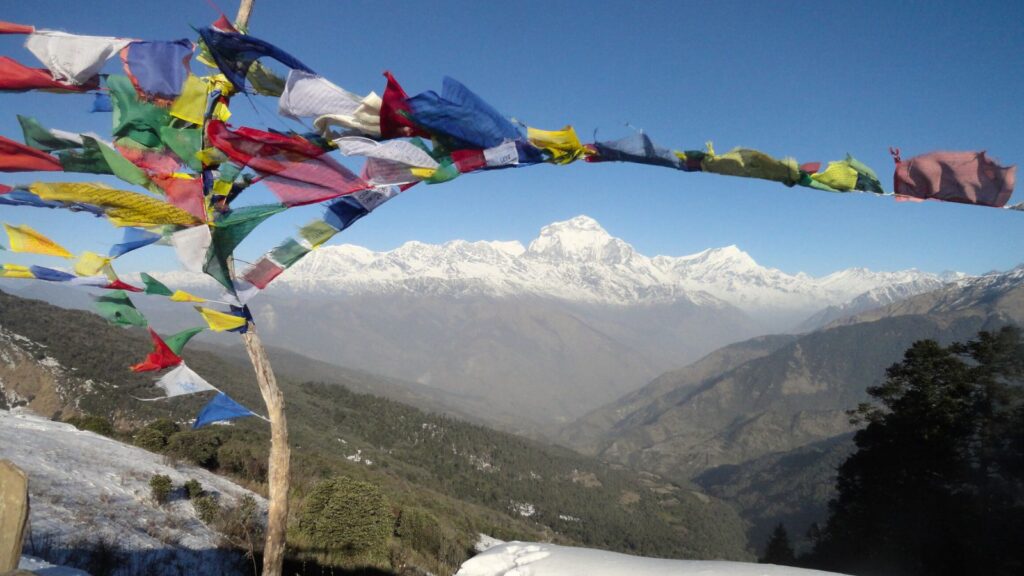
The Himalayas as a destination for meaningful adventure travel
Adventure in the Himalayas unfolds slowly and deliberately. Each step taken on ancient trails carries echoes of caravans, pilgrims, and wandering ascetics who walked these paths long before trekking became a modern pursuit. The slow pace of walking at altitude reshapes time itself. Days become measured by sunrise on snow peaks and evenings by the fading glow of prayer lamps. In this landscape, adventure feels less about speed or conquest and more about endurance, patience, and humility before nature’s scale.
Experiencing solitude and silence in the Himalayan mountains
Silence in the Himalayas possesses a rare depth. There is a lingering presence of stillness that sharpens awareness. The wind moving through alpine grasses, the distant call of a raven, the isolated prayer flags fluttering in the wind, and the low murmur of a glacier melting into a stream, all become part of a natural meditation. In this quiet, travelers often encounter themselves with an honesty that urban life rarely allows. The mountains offer space to listen inwardly, to thoughts long ignored, and to questions that only solitude can reveal.
Spiritual traditions rooted in Himalayan landscapes
The spiritual life of the Himalayas is inseparable from its geography. Monasteries cling to cliffs as if grown from stone, while temples stand beside rivers believed to carry blessings downstream. Prayer flags fade under sun and snow, their colors dissolving into the sky they are meant to touch. These traditions do not dominate the landscape; they exist in harmony with it. For visitors, witnessing daily rituals in such settings provides an understanding that spirituality here is lived quietly, woven into ordinary moments rather than proclaimed loudly.
Pilgrimage routes and sacred journeys in the Himalayas
Many Himalayan journeys follow paths fashioned by devotion rather than design. Pilgrimage routes trace river valleys, circle sacred peaks, ascend secluded hills, and ascend to hidden sanctuaries where faith has endured through centuries of isolation. Walking these routes carries a sense of continuity, as if each traveler becomes part of an unbroken procession. Even those without religious intentions often feel the gravity of these paths, sensing that movement itself becomes a form of contemplation in such surroundings.
The healing power of nature in the Himalayan region
The Himalayas possess a restorative quality that reaches beyond physical fitness. Clean air, slow movement, and immersion in vast landscapes gently recalibrate the body and mind. Many travelers speak of sleeping deeper, breathing fuller, and thinking clearer after days in the mountains. This healing is subtle and unforced, arising naturally from alignment with a simpler rhythm of life where daylight dictates activity and rest comes without distraction.
Why the Himalayas invite reflection and personal transformation
Personal transformation in the Himalayas rarely announces itself dramatically. It often arrives quietly, through moments of effort on steep ascents, through shared tea with strangers in remote villages, or through long evenings watching clouds drift across peaks. In the presence of the mountains, travelers are left to confront their own intentions, fears, and desires. Many return carrying less certainty, yet more clarity, having learned that the greatest journey offered by the Himalayas unfolds within.
Choosing the Himalayas for a journey that stays with you
To travel in the Himalayas is to accept that some experiences cannot be photographed or summarized. They linger instead as sensations and reflections, resurfacing long after the journey ends. The memory of thin air, vast skies, and quiet devotion remains, shaping how one views distance, effort, and meaning. This is why the Himalayas endure as a destination and remembered deeply as a place where adventure and introspection walk side by side along ancient trails.
